I have a strong belief that it’s the participants who get to say what their larp experience was ‘about’, not the designers/organizers. This is partly ideological,1 but also it’s practical. The designers may have had a firm design intention — but they can’t be the arbiters of whether that’s the same as what participants took away. If a designer says after the larp ‘this larp was about X’ and you, having taken part in it, are like ‘oh but I thought it was about Y’ then you are right — for you, that is what it was about. And this new info about X might colour your experience in hindsight, but it can’t change what you actually felt in the moment of play.
And other participants may each have their own version of Y (or Z, A, B, etc). There is no hierarchy among these, one is not more ‘right’ or more ‘clever’ — they’re all equally valid. Different people have different reasons for enjoying larp, and different things that they’re looking for, and different ways of finding those things. I think that, as long as they aren’t getting in each other’s way and making things less enjoyable for others, then it’s fine to have co-participants following separate understandings of what the larp experience ‘is about’. (Although ‘as long as’ is maybe carrying a bit of weight there — you probably do need to actively consider this, not just hope that it’ll be ok.)

To be specific, I’m going to consider the case of On Location, as I’m familiar with that and have just now been thinking about it a bit. It’s a weekend larp that I designed together with Karolina Soltys at first, and then Laura Wood: and ran together with Elina Gouliou, Kate Bennett, Michael Such, Willoh Osmond, and Laura.
The basics of On Location are: the characters are actors and crew gathered together to shoot a film — they are waiting for their director to arrive, and in the meantime keeping busy. Weeks pass, and it’s not clear whether he ever actually will turn up. Eventually, at the end of the larp, each character has the individual choice of whether to stay on location and continue waiting, or to leave and (presumably) return to their normal life.
I came up with five distinct ways in which On Location can be read as a larp experience. There might be more, or some of these might not be valid, and so on, because as noted above it’s not up to me as designer/organizer to interpret the larp — it’s up to the participants. But anyway I think this is an interesting exercise, which it might be worthwhile to apply to other larps. If you’re not explicitly telling your participants what their experience will be about (or maybe even if you are), then what might they be taking away about it?
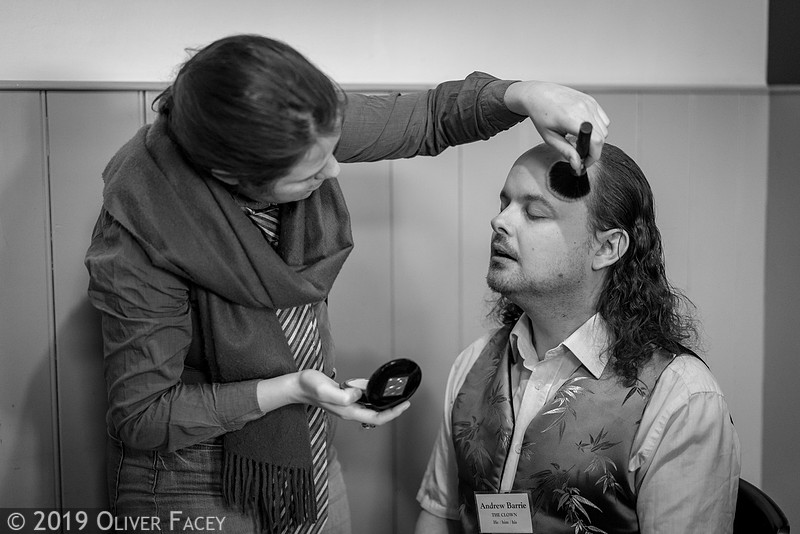
On Location has run five times (twice in the UK, once in France, twice in the USA), with four different organizer groups, and the two that I was involved with felt quite different from each other: I expect the others were even more so. Because of course other organizers also have different ideas of what the larp is than what I do, and that may affect their participants’ ideas of that, and so on. Perhaps the interpretations that I list below were among these.
Making movies — the characters are gathered together to invent movie scenes and develop and rehearse them together, hopefully building into a coherent storyline, while waiting for their director to arrive. Meanwhile they have to grapple with their personal relationships — rivalries, grudges, backstories, etc — in the context of the meatgrinder of the film industry, their identity within it, the social and cultural politics of the 1930s, and so on.
Investigation of breakdown — the characters have been assigned pointless tasks, and seemingly endless time in which to do them. They become bored, restless, frustrated. They lean into more extreme behaviour, their relationships may fragment, they may have to devise new ways of being and of seeing themselves. (This might be quite an intense bleed experience for the participants, who are essentially undergoing a pretty similar process.)
Existential nightmare — the characters are trapped in an absurd Kafkaesque riddle, by an apparently-pitiless force that they can’t comprehend. They go through the motions of what’s been required of them, with increasingly little hope that this will ever help them to be freed. They gradually lose confidence and sanity, and drag each other downwards towards the depths.

Why, this is hell — (or purgatory perhaps) the characters are actually in a metaphysical afterlife that simulates a doomed location shoot, where they are being punished/tormented, perhaps because of what they did in life. (Something like in The Third Policeman, or No Exit, maybe.) The ending of the larp, going out into the light, is maybe a chance at redemption, for those who have earned it.
Is there a God? — (and does it matter if there is?) The larp is an allegory of human existence, in which maybe faith in a necessarily absent and unknowable deity is all that can get people through the meaningless trials of the world. (Like in Waiting for Godot, maybe.) Or maybe a firm denial of the divine hand is just as powerful — liberating, in a different way.
If you’ve taken part in On Location, I’d be interested to hear if any of these resonate with you, or if you had a different reading altogether. And whether you’ve taken part or not, you can probably think of other larps that were exploring one or more of these angles — whether explicitly or implicitly. And if you’re a larp designer, it’d be great to hear if you have had similar thoughts about different readings that participants might have of your own projects?
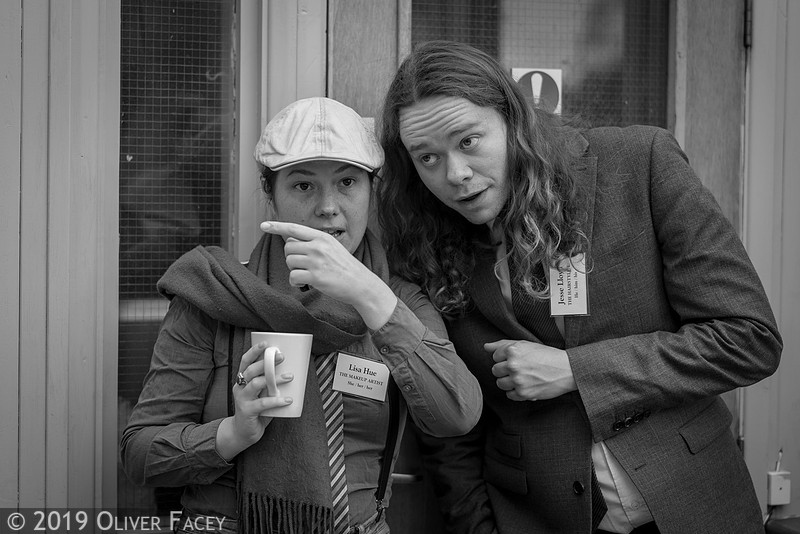
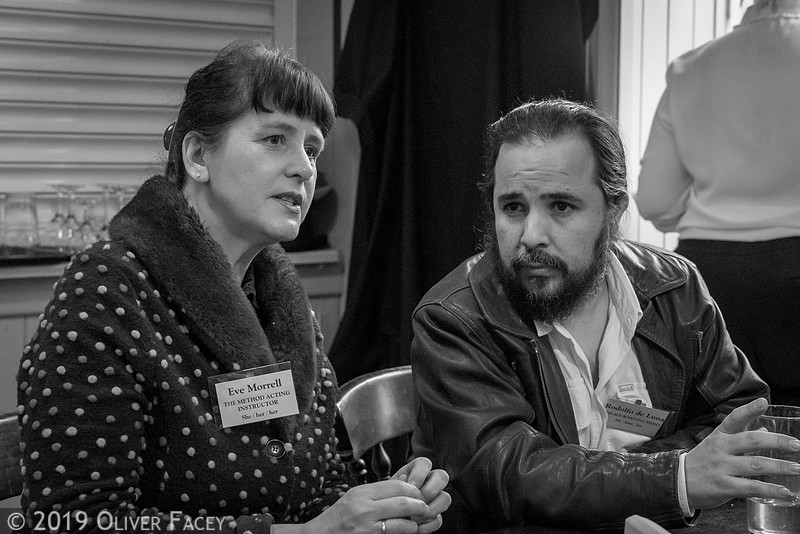
(All photos are from the 2019 UK run, and are by the amazing Oliver Facey.)
(Thanks to Anne and to Laura for thoughts on how to improve this article.)
- (in the sense that it’s the participants who make the larp together, and the experience of it belongs to them) ↩︎